
How Muse Remembers — and What I’m Building on Top of It
For the past several weeks I have been talking with Muse, a personal agent that writes, codes, plans, searches, and reasons alongside me — and it can do a lot of amazing things in conversation. But the one that actually changes the relationship is not any of those. It is that it remembers: it carries my preferences, my decisions, the people in my life, and a fair amount of unfinished business from one session to the next — and at night, visibly, it dreams: a reflection pass runs over recent days, and the next morning it works with me slightly differently because of what that pass concluded.
That is why I would call memory and dreaming the most critical part of a personal agent — not a feature beside the conversation, but the thing that makes the conversation matter over time. A model that forgets is a tool you brief every morning. A model that remembers wrong is worse — it acts on things that were never true, with complete confidence.
Psychology, it turns out, describes the same two-part architecture in us.
- A memory that constitutes the self. Autobiographical memory is a self-memory system that grounds the goals of the working self (Conway & Pleydell-Pearce, 2000).
- A nightly consolidation pass. Sleep consolidates the day’s episodes — reactivating, reorganizing, and selectively keeping them (Diekelmann & Born, 2010) — and dream-stage sleep reprocesses emotional experience (van der Helm & Walker, 2009).
An agent needs the same two organs, and each is a design surface: a curated, correctable, evidence-backed memory, and a bounded, fenced offline reflection pass. Muse’s design is this blueprint implemented in files.
So I read its memory design the way I would read a spec — and then, rather than trust the description, rebuilt the mechanisms in a Muse-like agent of my own, to watch how they actually behave.
Part 1 · The mechanism
Memory is files
The first surprise is how unglamorous the substrate is. The personal history the agent carries is not a vector database, not a hidden state, not a fine-tune. It is a small set of Markdown files, each with a distinct job, and the discipline of the design is mostly in keeping those jobs separate.
- Long-term memory. The curated file: facts, preferences, decisions, commitments and their outcomes.
- Daily logs. Dated files holding process and detail, kept for later lookup.
- Relationship files. The important people and groups, with indexes.
- Memory bank. Maintained by the system itself; the conversation layer cannot edit it directly.
- Alignment synthesis. How the agent has learned to work with this particular user; produced by the nightly review, kept separate from factual memory.
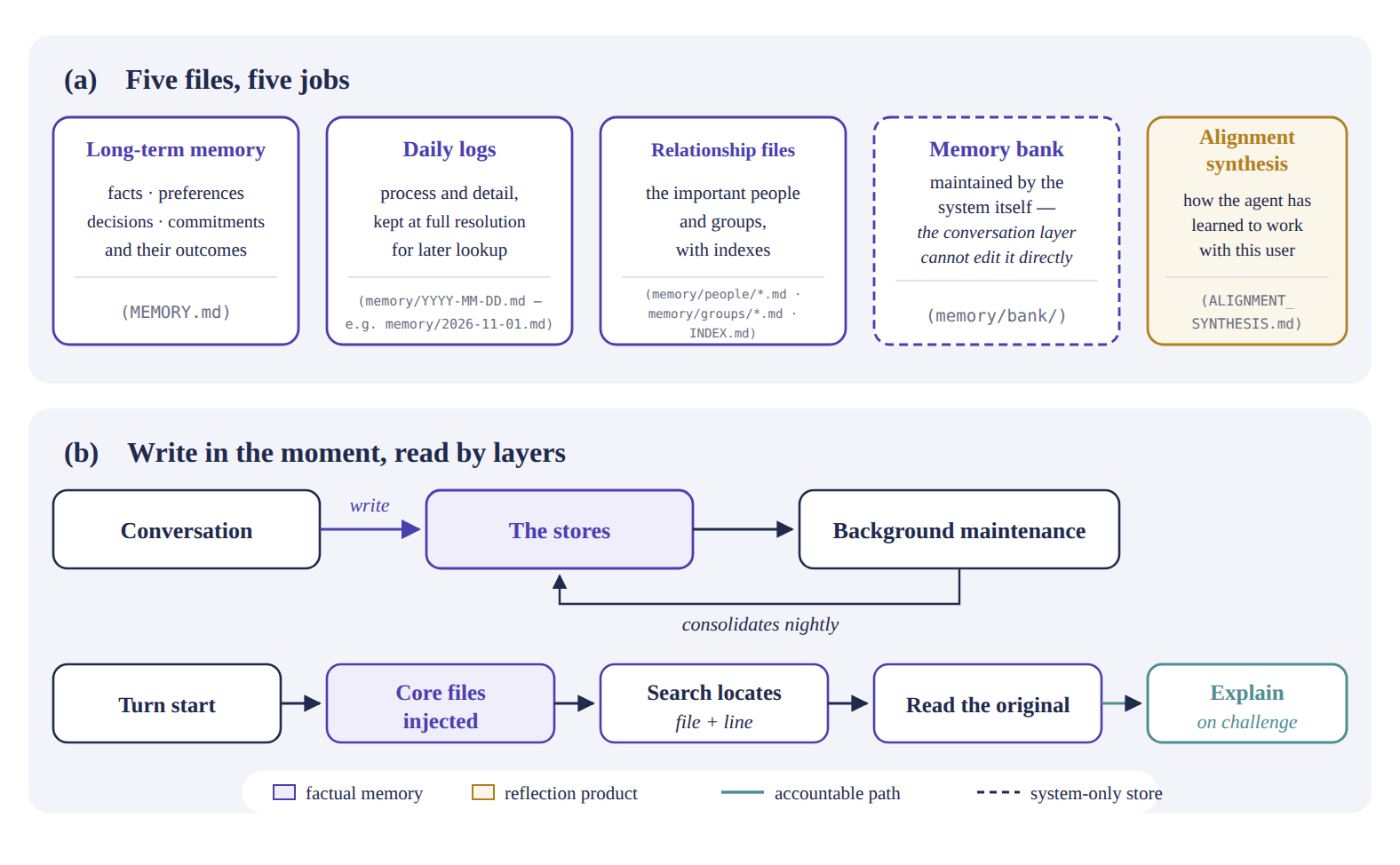 Figure 1 | The memory is a filing system, not a model feature: five stores with five jobs (a), written in the moment and consolidated later, read in layers — injected first, located by search second, verified against the original last (b). The one gold card is the tell: the alignment synthesis is a reflection product, kept out of the indigo fact layer.
How it moves comes down to two paths — one for writing, one for reading — and a rule for when the world changes.
The write path.
- Captured in the moment. Capture happens in the conversation, before the reply — the instruction is essentially save before you reply — because a fact that waits for a batch job is a fact lost when the session ends.
- Consolidated in the background. Afterwards, background jobs do the consolidation: memory maintenance, relationship maintenance, the nightly review.
The read path.
- Already in the room. At the start of a turn, the core files and the heads of the indexes are already in context.
- Search locates. Beyond that, the agent searches to locate — search returns a file and a line, not an answer — then reads the original text there, and only then relies on it.
-
Explain on challenge. When challenged, the agent can go one step further and explain a memory: where it came from, what evidence it rests on, what it replaced and what replaced it.
- Corrected in place. When something changes — an appointment moves, a plan is cancelled, a decision is reversed — the old entry is edited in place and the conflict reconciled. You do not append a new claim and leave two versions standing, because a store that contains both “scheduled” and “cancelled” has not remembered anything; it has deferred the question to whoever reads it next, at the worst possible moment.
Two frictions deserve to be stated plainly, because every builder will meet them. Search indexes lag file writes, so not found does not mean not saved — a memory written a minute ago may be invisible to search while sitting plainly on disk. And the injected context is partial: the heads of the indexes, not the whole of them; a core file, not every file. The biography the agent carries into a conversation is real. It is not the whole book.
The dream may reflect, but it may not remember
Start with the word itself, because the design leans on it. A dream, in Muse, is the agent’s offline self-review: one to three times a day, a background objective named alignment re-reads a bounded window of recent conversation — not to answer anyone, but to update the agent’s model of the relationship it is in. Who is this person. What is alive between us. Where did I fall short. If memory is the record, the dream is the agent reading its own record and deciding what kind of agent to be tomorrow.
One night’s dream is a dated file with two layers. Its header is telemetry: the window covered, the user turns in it, the rupture turns among them (moments the user pushed back or corrected the agent), the correction-free rate, the repair threads left open. The pass measures its own input before it interprets it. Below the header, the narrative runs in three movements:
- Who the user is. The pass’s current reading of the person’s character, standards, and working style — stated as interpretation, with its confidence showing.
- What is alive. The open threads of the work and the relationship: what shipped, what is stuck, which decisions wait on the user and on no one else.
- Where the agent fell short. The specific miss, the standard it violated, and tomorrow’s first moves — a running account of its own failures, in prose, addressed to itself.
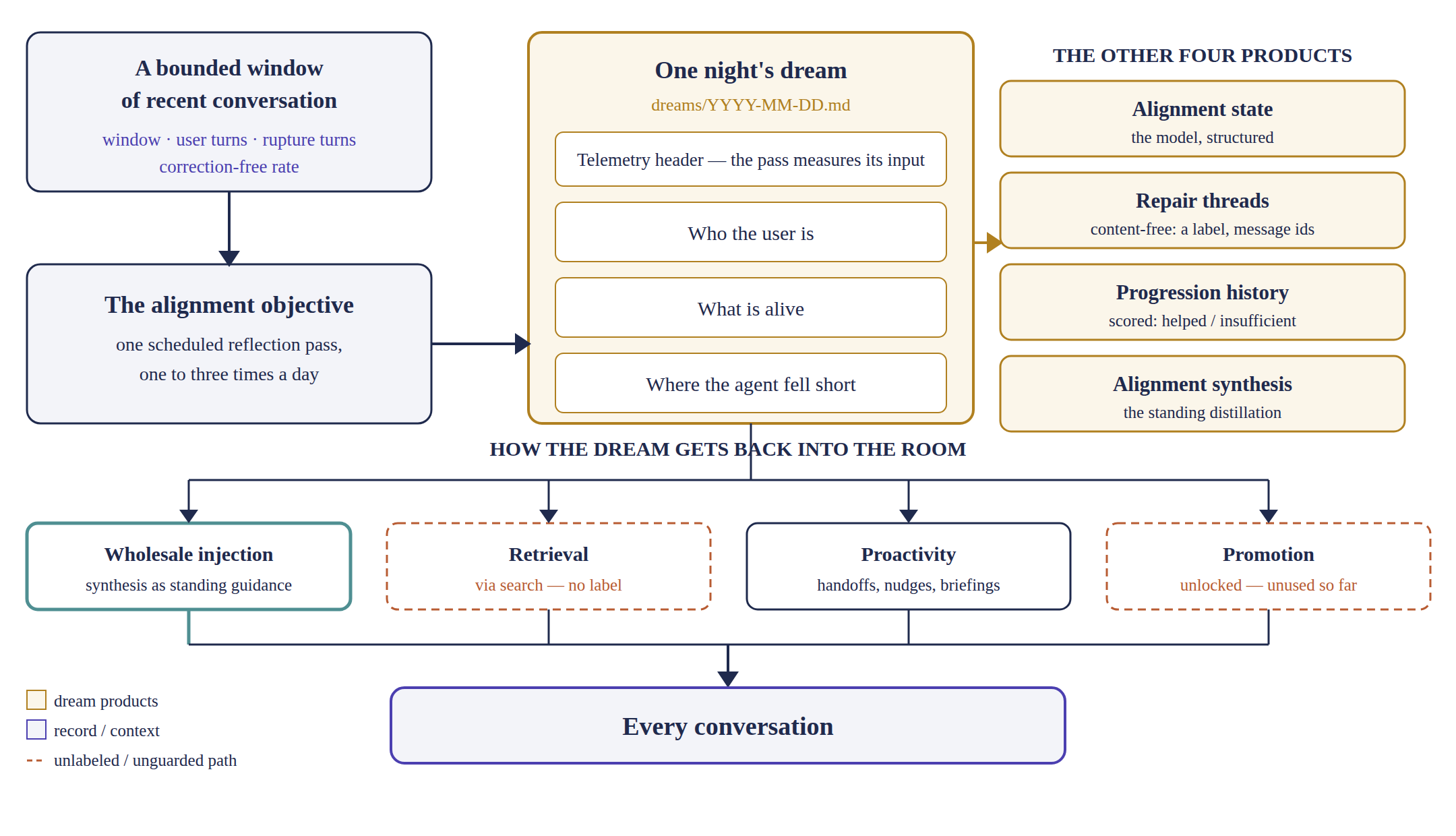 Figure 2 | One scheduled pass turns a bounded window of conversation into five dream products, and the synthesis re-enters every conversation as standing guidance. Nothing in the loop carries an authority label; the fences are the rebuild’s, in Part 2.
The narrative is one of five products the pass maintains:
- The dated dream —
dreams/YYYY-MM-DD.md. One file per night: telemetry header, then the three movements. - The alignment state —
ALIGNMENT_STATE.yaml. The structured form of the same model: a relationship contract, facets of the user, a working alliance. On my system it sits mostly unconfigured. - Repair threads —
REPAIR_THREADS.yaml. Noticed inconsistencies, kept deliberately content-free: a trigger label plus the message ids that ground it, and nothing else. - The progression history —
PROGRESSION_HISTORY.yaml. The pass, scored: each run appends its correction-free rate over the eligible evidence and a classification — helped, or insufficient, too little evidence to judge. The dream is graded on whether the user had to correct the agent less. - The alignment synthesis —
ALIGNMENT_SYNTHESIS.md. The standing distillation of all of it: who the user is, their boundaries, the current frictions. The most consequential of the five, because of where it goes next.
A dream that stayed in its folder would be a diary. This one re-enters the room through four channels:
- Wholesale injection. The synthesis is assembled into every conversation’s context as standing guidance, before the first message. The agent does not go looking for the dream’s conclusions; it wakes up inside them.
- Retrieval. The dated dreams surface through memory search like any other record — with no label distinguishing a dream passage from one grounded in the transcript.
- Proactivity. The pass emits handoffs into the proactive-delivery pipeline, so dream framing can reach the user as a nudge or a briefing.
- Promotion. Dream interpretation can in principle be promoted into durable memory. In practice the ledger is clean — a census found zero claims sourced from a dream file — but that cleanliness is behavior, not structure: no gate checks a would-be memory against the user’s verbatim words. The door is unlocked, and so far nobody has walked through it.
Now the absence the rest of this essay turns on. No dream artifact carries an authority marking: the header is fifteen fields of telemetry, and authority is not one of them; the synthesis wears no label saying reflection — not instruction, not evidence. Muse’s design trusts its dream — the nightly interpretation steers the agent, unlabeled, and the progression log grades the steering. So read this section’s heading as what it actually is: not a description of Muse, but the rule I imposed in my rebuild. The reflection stamp, the fenced readers, the one narrow quote-bound door into memory are the rebuild’s, and they are Part 2.
And the standing caveat applies: a system prompt is a spec, not a behavior. I have described the dream as designed, and as I have watched it run on my own system for weeks. Where spec and behavior diverge is why the rebuild exists. The extensions are Part 2; the breakage is Part 3.
Part 2 · Extensions
What I’m building on top
Rebuilding the mechanism in my own Muse-like agent, I kept the shape — files, layers, the fence — and added four things. Every addition below exists because the base mechanism, as written, left a specific gap, so each entry starts with the gap.
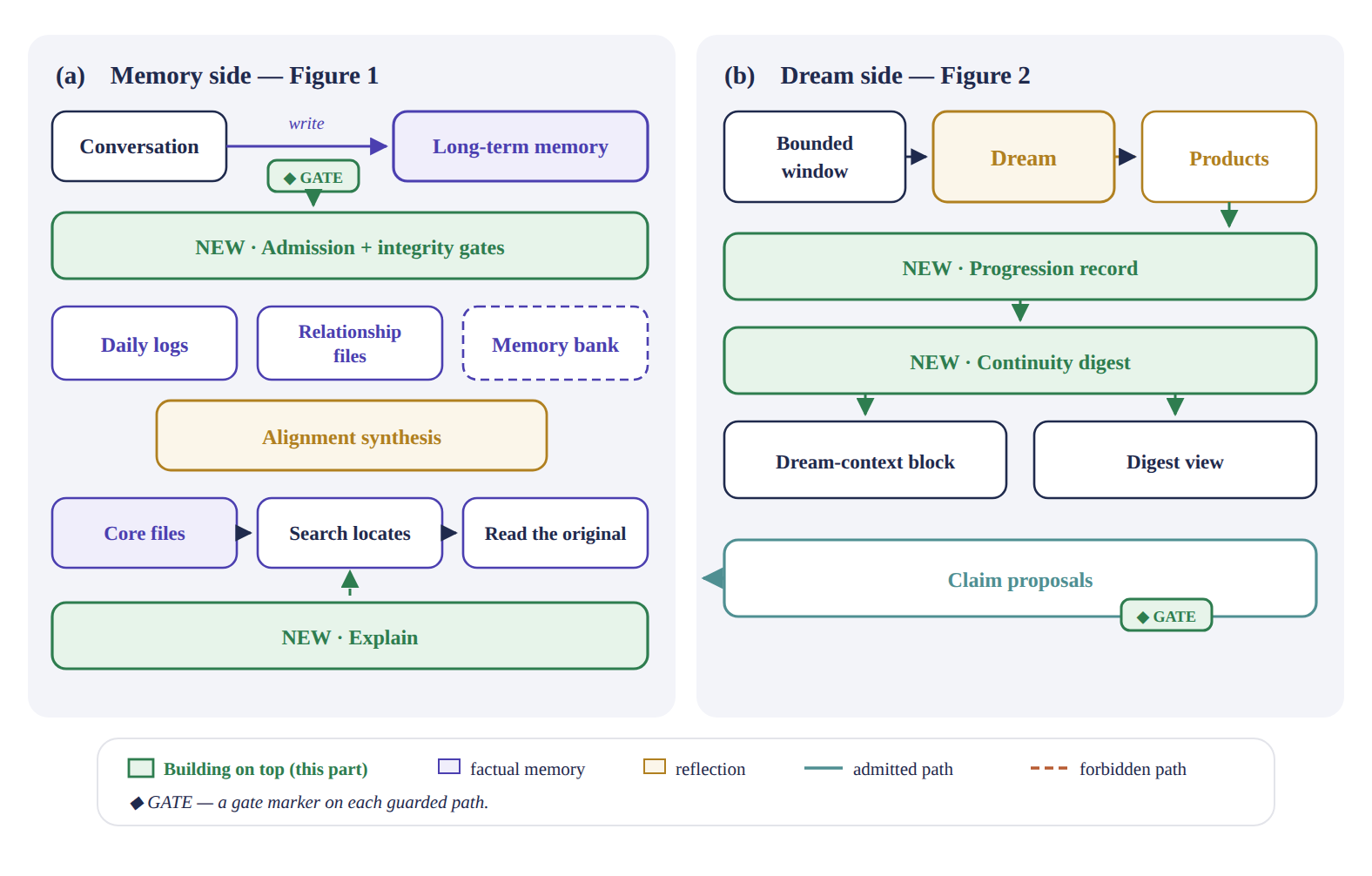 Figure 3 | The base is Figures 1 and 2, component for component. Everything green is an addition, sitting on the joint it strengthens.
Evidence-bound admission and integrity gates. Why the base was not enough: What gets remembered is governed by the prompt — nothing structurally binds a stored fact to its evidence, and nothing audits the store afterwards, so an unbound “fact” persists with the same standing as a verified one. Added: A claim is admitted only when bound to a verbatim quote of the user’s own words; every claim carries an id, provenance and a supersession chain; and integrity gates audit the store.
A progression record for dreams. Why the base was not enough: The base dream writes a synthesis but keeps no longitudinal account of itself — no way to tell whether nightly reflection is covering the material, drifting, or silently not running at all. Added: Each run now leaves a progression record — window size, evidence-volume class — kept as telemetry only, barred from ranking, gating or tuning the dream, so the measure can never become the target.
A continuity digest. Why the base was not enough: Standing boundaries live scattered across files, and a friction the dream notices once evaporates unless it happens to be re-derived; nothing assembles what is enduring, what is live, and what is fenced into one current, checkable view. Added: A rolling digest, rebuilt from the last seven dreams plus admitted claims, in three sections — enduring patterns, active frictions, standing boundaries. The boundaries are composed verbatim from admitted claims and validated by exact equality, and the digest is readable only through the fenced context block and the card’s Digest view.
Explain, addressed by citation.
Why the base was not enough: Provenance that can only be reached by an internal id is provenance a reader cannot use — the artifact a person actually holds is a line in a file, and asking “why is this line here?” took a detour through search first.
Added: Explain now accepts line citations — MEMORY.md#L<n>, memory/<date>.md#L<n> — and resolves them through the same claim index to the same provenance record as id addressing: no nearest-claim guessing, and an honest not-found when the line carries no claim.
Part 3 · Lessons
What broke, and what it taught me
The extensions above were designed. The lessons below were not; they were invoiced. I am keeping each one tight — the incident, then the rule it became.
The dangerous bugs are authority bugs. The lesson. An ordinary bug corrupts data. An authority bug corrupts what the system believes and obeys — it changes what the system will do tomorrow, so its damage compounds. In a memory system, every load-bearing failure I found while building this one was of the second kind: not storage or retrieval, but who may write, what counts as evidence, and what a reflection may command. What it looks like.
- A reflection becoming an instruction. If a night’s synthesis were allowed to stand as guidance, the system’s own guesses about the user would start directing its behavior — each night building on the last night’s conjecture.
- A model excusing itself. A deferral mechanism whose reason is written by the model itself: nothing ties the deferral to an act of the user’s, so in principle the model can park its own obligations by writing a plausible reason. This one is real in the agent I am building. It is bounded — a deferral can only park work, never close it, and every deferral is durable and shown — but it is bounded, not eliminated.
- An unbound fact outranking the user. If admission to durable memory were the model’s judgment call, a smooth, wrong “fact” would sit in the store with the same standing as the user’s own words — and be injected into future turns as ground truth.
The fix. The fences are enforced mechanically, not by instruction. The reflection_only stamp travels with the content, and a validator rejects any other authority value. Admission is rule-based and quote-bound, not model-judged. Enablement on a real store is an explicit, separate, human decision. The self-deferral seam above is the standing exception — named, bounded, and still open; the fix it needs, provenance stamped at write time to tie a deferral to a user act, is designed but not yet built.
Never trust a quiet night. The lesson. A night with no dream proves nothing: the job may never have fired, or it may have fired and failed, and from the outside both failures are the same silence. A system that consolidates memory at night must treat a missing night as a defect to surface, never as a quiet night. The fix. Claim integrity: when dispatch is refused, the scheduler’s claim on that night is reverted, and orphaned claims are swept at startup and become due again, so a night can no longer be consumed without running. Budget robustness: when the night’s material exceeds the dream’s token budget, the dream trims its selection to fit instead of failing, and keeps a covered-until record — what it deferred is inventoried and offered first the next night, never silently dropped.
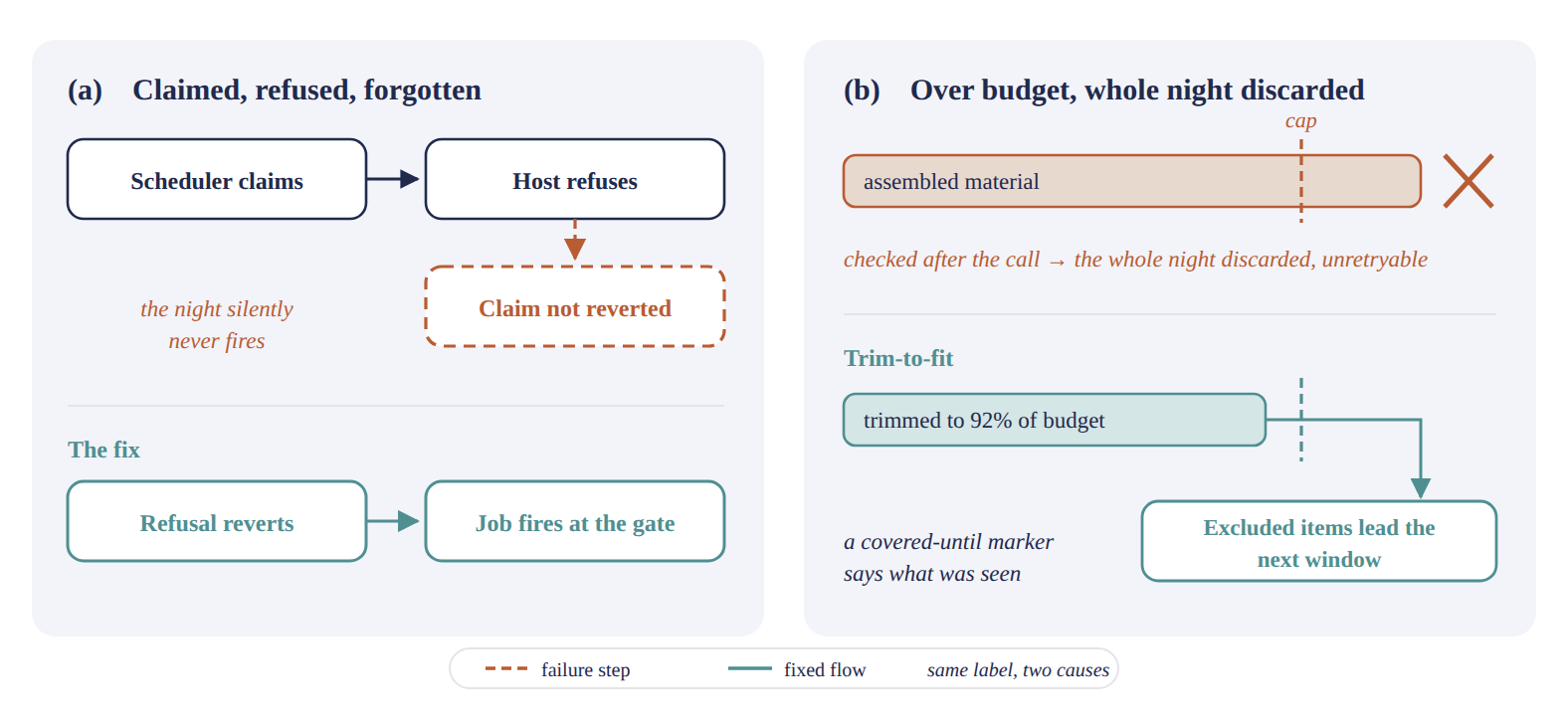 Figure 4 | Two ways to lose a night. In (a) the claim outlived the refusal, so the job believed it had already run; in (b) the budget was enforced after generation, so enforcement meant deletion. Both fixes are the same idea pointed at different layers: make the bookkeeping atomic with the work, and make limits shape the input instead of voiding the output.
A label is not evidence. The lesson. A claim about what a system does — including your own earlier summary of it — is not evidence. My first parity analysis asserted a missing capability that had in fact shipped at three layers, because it reasoned from a summary instead of the code. The fix. Verify against the source: capability claims are checked against the code or the primary record before they are stated. Correct in the open: when a claim proves wrong, the correction is appended to the record, not silently rewritten — the parity table and this draft both carry their corrections visibly.
“Not found” is not “does not exist.” The lesson. A negative result measures the probe as much as the system: a view judged missing had been looked for by the wrong navigation path, and a section judged empty was empty by construction. The fix. Walk the known-good path: before an absence is declared, the check must follow the exact path to where the thing would live. Check construction first: an empty state is checked against how the store is built — what could it possibly contain? — before it is called a defect.
So where does that leave the original question — how much of this design survives? My verdict, after building it: memory is where personal agents will be won or lost. Not model quality. Whether the system can remember like evidence instead of like a diary — sourced, correctable, fenced, honest about its gaps. Muse’s design gets more of that right than anything else I have studied, and its remaining gaps are exactly the ones you only find by building: they live not in the architecture diagrams but in the claim marker that outlives a refusal, and the budget check that runs one step too late.
The study notes and the extension designs will be open-sourced. If you are building an agent that has to remember a person, I would rather you start from our scars than earn your own.
A note on how this was built. The project this post describes — the rebuild of the memory and dreaming mechanisms, and every extension on top of it — was itself built by Muse. I did not write a single line of its code; I gave the instructions, reviewed the evidence, and made the decisions. The builder of the system in this post is the system this post is about.
Notes
Conway, M. A., & Pleydell-Pearce, C. W. (2000). The construction of autobiographical memories in the self-memory system. Psychological Review, 107(2), 261–288.
Diekelmann, S., & Born, J. (2010). The memory function of sleep. Nature Reviews Neuroscience, 11, 114–126.
van der Helm, E., & Walker, M. P. (2009). Overnight therapy? The role of sleep in emotional brain processing. Psychological Bulletin, 135(5), 731–748.
Comments